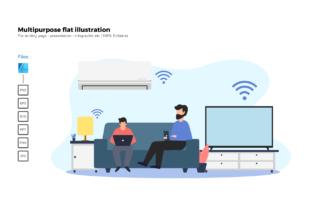
Flat Illustration Smart Home: Graphics & Illustrations Review
First Impressions: Assessing the Visual Tone for Tech Clients
When evaluating a new graphic design asset for a client in the smart home or IoT sector, my primary concern is balancing technical complexity with human warmth. Technology often feels cold and intimidating to consumers, so the right creative design must bridge that gap. Upon reviewing the Flat Illustration Smart Home collection, the immediate impression is one of accessible modernity. The visual language avoids the overly futuristic, neon-drenched aesthetic that dates quickly, opting instead for a clean, approachable flat style that communicates safety, ease, and integration.
For a recent project involving a boutique home security startup, this specific mood was essential. The client needed illustrations that felt premium yet friendly enough for a family-oriented demographic. This asset pack delivers that balance through soft geometry and intentional negative space. It does not scream "tech demo"; rather, it whispers "modern living." As a digital product, it succeeds because it understands that smart home branding is ultimately about lifestyle enhancement, not just hardware specifications. The vectors are constructed with scalability in mind, suggesting they were built by designers who understand how these assets will actually be deployed across various touchpoints.
Deploying Vectors Across Brand Identity and Packaging
In a real-world scenario, versatility is the metric that matters most. When I integrated Flat Illustration Smart Home into a comprehensive brand identity system, the 100 editable files proved their worth during the packaging design phase. We were creating unboxing experiences for a smart thermostat and hub. The ability to isolate specific elements—like a stylized Wi-Fi signal or a simplified house outline—allowed us to create custom patterns for tissue paper and box interiors without the artwork feeling repetitive or cluttered.
For logo design support, these graphics serve better as complementary marks than primary logomarks. They are excellent for app icons, favicon sets, or secondary badges on product labels. In packaging design, the flat style ensures that details remain crisp even when printed on textured cardboard or matte finishes. Unlike complex 3D renders that can get lost in print, these vector shapes hold their integrity. For clients selling physical goods on Etsy or through print-on-demand services, this reliability reduces production errors and returns caused by poor print quality.
Editorial and Web Design Applications
Beyond physical products, this asset shines in web design and editorial layouts. While working on a landing page for an entrepreneurship blog focused on home automation, I utilized these illustrations as hero graphics. The multipurpose nature of the template descriptions meant I could swap color palettes to match the site’s dark mode and light mode seamlessly. For social media graphics, particularly Instagram carousels explaining complex setup processes, the consistent line weight and style maintained visual cohesion across ten different slides. This consistency builds trust; when a user sees the same artistic language from an ad to the checkout page, it reinforces brand legitimacy.
Where the Asset Excels Versus Where to Exercise Caution
No single design bundle is a universal solution. Flat Illustration Smart Home performs exceptionally well in large layout areas where the simplicity of the forms can breathe. It is ideal for product mockups, website headers, and educational infographics. If you are creating Canva templates for tech bloggers or real estate agents marketing smart homes, this set provides a professional foundation that elevates DIY designs above generic stock art.
However, caution is required in specific contexts. Because the style is inherently flat and simplified, it struggles in small sizes where intricate details might be necessary to convey specific device functions. Avoid using these in crowded layouts with heavy text overlays; the minimalist aesthetic clashes with dense information architecture. Furthermore, for ultra-luxury or high-end corporate finance clients within the smart sector, this style may feel too playful. It targets the prosumer and residential market perfectly but lacks the gravitas required for B2B enterprise infrastructure marketing. Always assess the client's position in the market before committing to this specific visual direction.
Impact on Hierarchy and Emotional Connection
The true value of this clipart collection lies in its effect on visual hierarchy. In marketing visuals, these illustrations act as anchors. They guide the eye without competing with the headline copy. When paired with strong typography, they create a rhythm that makes technical content digestible. Emotionally, they soften the "surveillance" aspect of smart home tech, reframing cameras and sensors as guardians of comfort rather than intrusive gadgets. For small business branding, this emotional translation is often the difference between a bounce and a conversion.
Technical Due Diligence: A Designer’s Pre-Flight Checklist
Before clearing any commercial design asset for a paid project, rigorous testing is non-negotiable. Here is my practical workflow for validating Flat Illustration Smart Home:
- Monochrome Testing: Immediately test the vectors in solid black and white. If the illustration relies solely on color to define form, it will fail in single-color applications like embossing or receipt printing. These assets passed this test, retaining clarity without color cues.
- Contrast Verification: Check visibility against both pure white and deep charcoal backgrounds. Smart home apps frequently use dark mode; ensure the PNG design files have sufficient contrast or include light/dark variants.
- Typography Pairing: Test alongside your chosen fonts. This flat style pairs beautifully with geometric sans-serifs and rounded display fonts. Be wary of pairing it with ornate scripts or traditional serifs, as the stylistic dissonance can look unprofessional.
- File Format Inspection: Verify that the SVG design files have clean node structures. Messy vectors cause issues in Cricut projects and laser cutting. Open the files in Illustrator or Affinity Designer to ensure layers are organized and editable.
- Licensing Confirmation: Always review the commercial license terms. Confirm whether the asset allows for resale in templates, use in NFTs, or unlimited client projects. For Etsy product sellers and digital creators, understanding these boundaries prevents legal headaches later.
- Print Quality Check: Print a sample at actual size. Screen resolution is deceptive. Ensure edges are sharp and colors are accurate for sticker design or t-shirt design applications.
Final Verdict for Professional Use
Flat Illustration Smart Home represents a high-utility addition to a professional designer's library, specifically for those servicing the residential technology, real estate, and modern lifestyle niches. It is not merely a collection of pretty pictures; it is a functional toolkit for solving communication problems in the smart home space. Whether you are building a sublimation design for custom merchandise, crafting editorial design for a tech publication, or developing a full brand identity for a startup, this asset offers the flexibility and polish required for commercial work. By applying proper technical checks and respecting its stylistic boundaries, designers can leverage this collection to deliver results that feel bespoke, trustworthy, and visually resonant with today’s connected consumer.